


Kara-shishi
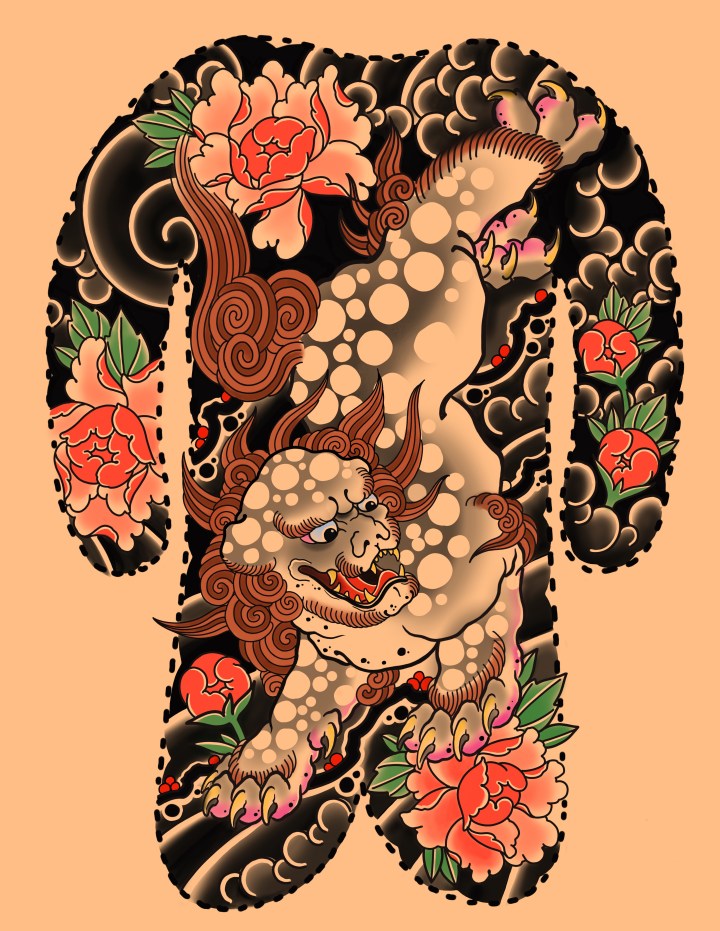
The shishi was most likely introduced to Japan from China via Korea in the 7th or 8th century AD. The Japanese shishi combines both elements of the Koma-Inu (Korean dog) and the Kara-shishi (Chinese lion). The statues were placed on either side of the entrance to a shrine or temple to ward off evil spirits. In the early Heian period both statues were clearly distinguishable. The one that sat on the left was called Shishi (lion) with it’s mouth open, and the one sitting to the right was Koma-inu which more resembled a dog with it’s mouth closed. Earlier depictions of Koma-inu had a single horn atop it’s head. Eventually the horn was no longer included in the depictions and the term Koma-Inu was used for both statues. At that point, other than the mouths being either opened or closed, the shape of the figures were nearly identical. Today, the term Shishi is most commonly used in reference to both Kara-Shishi and Koma-Inu.
In China, the lion is considered the master of all felines. A symbol of power and success, royalty and strength. In Korea the skin of the Koma-inu’s head is said to be stronger than that of a helmet. In Japan, the shishi protects the entrance to shrines, temples and sometimes tombs. It is said the shishi is sometimes tattooed on a woman’s belly to protect her during childbirth. Buddhist deities are sometimes seen riding atop the shishi, such as Monju Bosatsu. Shishi are also considered the messenger of the Bodhisattva of wisdom, Monju. They are considered a Buddhist symbol of power and protection.
You will almost always see the Shishi being paired with botan (peonies). In ancient China, the botan was considered “Queen of the flowers” and the Shishi was considered the “King of animals”. Together they are considered to be fitting companions. Another story linking the botan and Shishi is that of a Japanese monk who set out on a journey seeking knowledge. He traveled to Wutaishan (Mt. Wutai) the home of the Bodhisattva of wisdom, Monju. When the monk was about to cross a narrow bridge he was approached by a youth carrying firewood. the youth warned the monk to not move forward as the land beyond is infested with lions that would devour him if he was not protected by a spiritual power. As the monk paused to ponder the words of the youth, the area suddenly was filled with a wonderful fragrance and the air around him rang with beautiful music. The youth revealed his true self as the Bodhisattva Monju, and a Shishi emerged form the forest and danced around a growing peony.
Koi

Koi. Easily the most recognizable design in Japanese tattooing. The koi fish is the first image that pops in to many peoples head when they think of Japanese tattooing, but, for good reason. The image itself, in my opinion, is one the strongest and most classical piece you can get. It will fit beautifully on any part of the body, if done properly, the shape of the fish accompanied by water, flowers or maple leaves will compliment and make dynamic any area you wish to place it.
The koi fish or Nishikigoi (coloured carp) are admired for their endurance and perseverance in the face of adversity. The Chinese believe they represent good fortune in business and academics while Buddhist see it as a representation of courage. The date of when the koi was introduced to Japan is unknown, although records do show breeding of the fish on the island of Honshu as early as 1800. The koi itself were originally found in central Europe and Asia with domestication starting in east Asia where they were used as food fish.
I generally try and pair the koi with either cherry blossoms or maple leaves, depending on which direction the koi is going. Going up would be going against the stream in the fall which needs the maple leaves and going down needs the blossoms to show the spring season. One popular legend of the heroic fish is that of a thousand koi swimming up the Yellow River in China fighting the strong currents. At the end of the river lies a waterfall know as the Dragon’s Gate. Most of the koi turned back because the strength of the current and the falls proved too difficult. But some remained, where they tried for a hundred years to reach the top of the falls. Eventually one did leap over the waterfall, the gods approved of his heroism and persistence and turned him into a golden dragon.

Kannon
Kannon, the goddess of mercy. There are multiple depictions of Kannon. I have chosen the image of her riding down from Mt. Fudaraku atop a dragon to great those seeking her salvation. Other images would be of Kannon riding atop a koi, sitting in a lotus and numerous others. Kannon is a Bodhisattva which means she has prolonged her own eternal enlightenment to help those who suffer in this world. Kannon presides over the Pure Land Buddhism. She is one of the attendants of Amida Buddha along with Seishi Bodhisattva. Kannon to represent compassion and Seishi, wisdom. 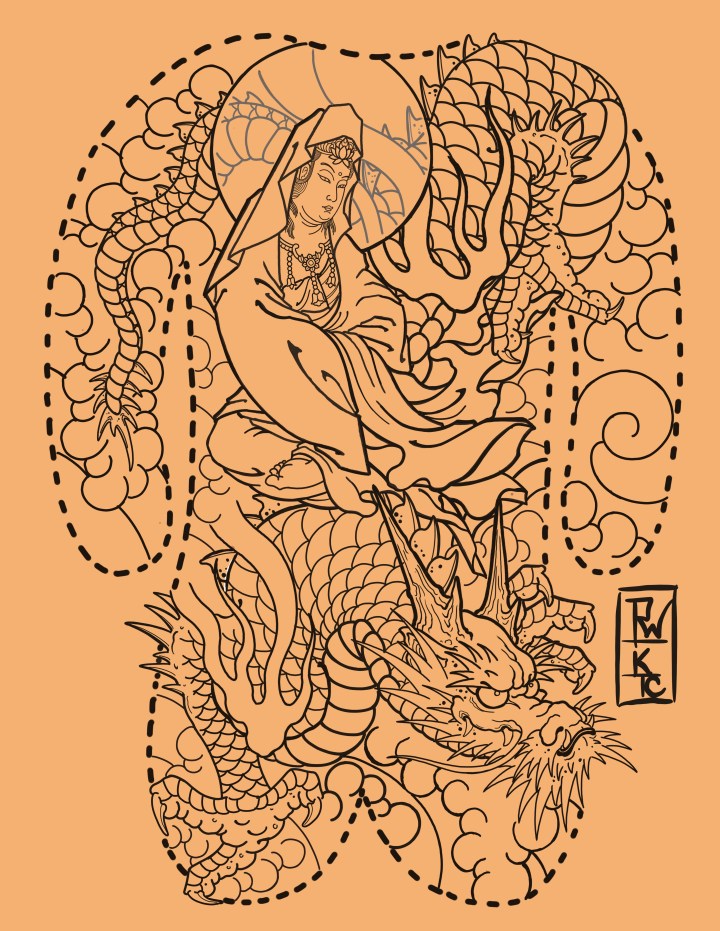
Kintaro
Kintaro (the golden boy) is another powerful piece that I have always loved since the first time I saw it. There are many stories relating to Kintaro. Some say he was left in the forest area of Mount Ashigara by his mother, to be taken in and raised by the mountain witch Yama-uba, others claim the mountain witch was his mother, impregnated by thunder sent from a dragon. But all tales, no matter how they start, all agree that Kintaro was a boy of immense strength and courage. He wore only a bib with the kanji for gold printed on it and usually carried with him an Ono (hatchet). His friends were mainly the animals of Mt. Kintoki and Mt. Ashigara. He was capable of smashing rocks into pieces and uproot trees. Some say, he was able to speak with the animals befriended. Many tales tell of Kintaro fighting monsters and demons. Also there has been depictions of him from some of the great ukiyo-e masters fighting boars, bears or giant koi as depicted in my drawing below. Some believe the stories of Kintaro are based in truth. That he was a real person who later in adult life, changed his name to Sakata Kintoki. He would have lived during the Heian period and had served as a retainer for the samurai Minamoto no Yorimitsu. 
Tora
The tiger as a backpiece has always struck me as an extremely powerful image. It represents strength and courage. The tiger is sometimes chosen for protection from bad luck, evil spirits or to ward off illnesses. Tigers are said to be able to control the wind. Often times you will see them fighting Oni alongside Shoki, the demon queller. 
Karyobinga
 Karyobinga are celestial beings who play music, dance and fly through the air, a fantastical, immortal creature in Buddhism and are sometimes associated with Amida Nyorai. They are said to recite buddhist scripture with their beautiful melodic voice. They live in the buddhist paradise (gokuraku-jodo). It’s voice is a descriptor of the buddhas teachings.
Fudo Myoo
This here is one of my favourite subjects to be done as a backpiece. Fudo Myoo is a wraithful deity, the protector of buddhism. His Sanskrit name is Acala. His name literally means “The immovable wisdom King.” Fudo Myoo one the five wisdom kings along with Gozanze, Gundari, Daitoku and Kongoyasha. When the five kings are represented together, he usually is in the middle.
He converts anger into compassion and cuts the ties of negative feelings and demons to liberate us from suffering through self control. The Myoo-o figures appear ferocious and menacing. They are designed to subdue evil and frighten non believers into accepting Buddhist law. They represent the luminescent wisdom of Buddhism, protect Buddhist teachings, remove all obstacles to enlightenment and force evil to surrender. 
Introduction to the art of Japanese tattooing.
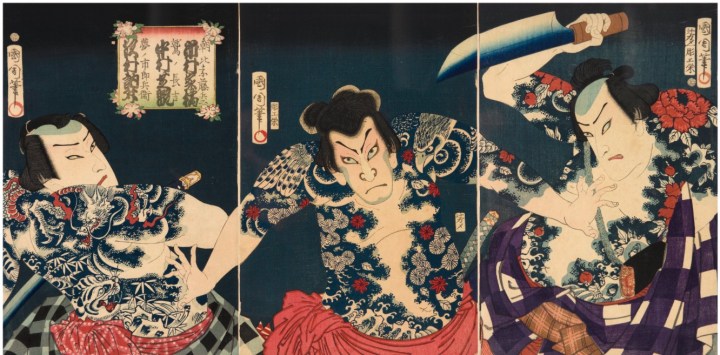 Japan has had a very long and extensive history with tattooing. The art of irezumi has been has been used by all classes of society, at certain points in time, it was commonplace for everyone to be tattooed, it has been used to mark criminals and has been outlawed all together. The earliest evidence of tattooing has been found in tombs which date back to 5000bc. Clay figures had been unearthed in these tombs with the faces either painted or engraved to represent tattoos. 297ad was the first recorded accounts of tattooing in Japan by the Chinese. In their historical accounts it was written that all men both young and old, had their faces and bodies decorated with tattoo designs. The first record of penal tattoos of Japan was in 720ad when the emperor had decided to take pity on a man who had committed the crime of plotting to rebel and overthrow the state, which was punishable by death, instead having him tattooed with his crime for all to see. By the early 17th century tattooing was a widely accepted form of punishment. The markings denoted many of the crimes. By the latter part of the century penal tattooing had been replaced with other forms of punishment due to the fact that more elaborate and decorative tattooing had gained in popularity, many of the tattooed criminals having their markings covered with new designs. In the 18th century tattooing continued to flourish among firefighters and labourers. They would get tattooed with the idea of it giving them strength, courage or as a symbol of protection. Firefighters for example would sometimes have their bodies tattooed with a dragon for the strength and water for protection against the flames.
The japanese tattoo is steeped in meaning and tradition. They are meant to tell a story. There are many rules to observe when designing a Japanese tattoo. In contrast with western styles of tattooing, the Japanese tattoo is to continue harmoniously throughout the entire body. Each piece relating back to the other and recounting the tale of the epicentre of the bodysuit, the backpiece! The back is where the whole process of the Japanese bodysuit is to begin. It is the focal point of the suit. The arms, legs, chest and side panels are dictated by what has been placed on the back. The rest of the body is just a continuation of the story. 
First blog post
I started this blog to share my passion on Japanese tattooing, to educate people as best I can on the traditions, the history and the magic of the art. I will displaying ideas for bodysuits that will be available to be tattooed along with explanations of the meaning behind the pieces.
 The bodysuit project